


- Samar R.
- October 15, 2026
-
- 0
Ranking #1 on a page nobody clicks is a trophy for a game that ended.
I know that sounds dramatic. For twenty years, the deal with Google was simple: rank higher, get the click, win the customer. Most of the businesses we speak to still plan their marketing around that deal.
The deal has changed. Your buyers now ask an AI first, and AI search visibility, whether your business gets named in the answer, has quietly become the new first page.
In short:
• When Google shows an AI Overview, the #1 result now gets 58% fewer clicks than it did two years ago.
• Most shoppers already use AI tools to research what to buy, and the AI hands them a shortlist of three or four names.
• AI doesn’t pick the best business. It picks the one it can understand and trust. That part you can fix.
How AI Overviews are changing Google clicks
In February 2026, Ahrefs looked at 300,000 keywords. When an AI Overview appeared, the top-ranking page earned 58% fewer clicks than it did in December 2023. Eight months earlier, the same study had measured 34.5%. (Ahrefs, via AP).
So it isn't levelling off. It's getting steeper. And this is no longer a "correlation, not causation" debate. A randomised study of 1,065 Chrome users, reported in July 2026, found AI Overviews cut clicks to websites by 39.8%. (Something Inc.)
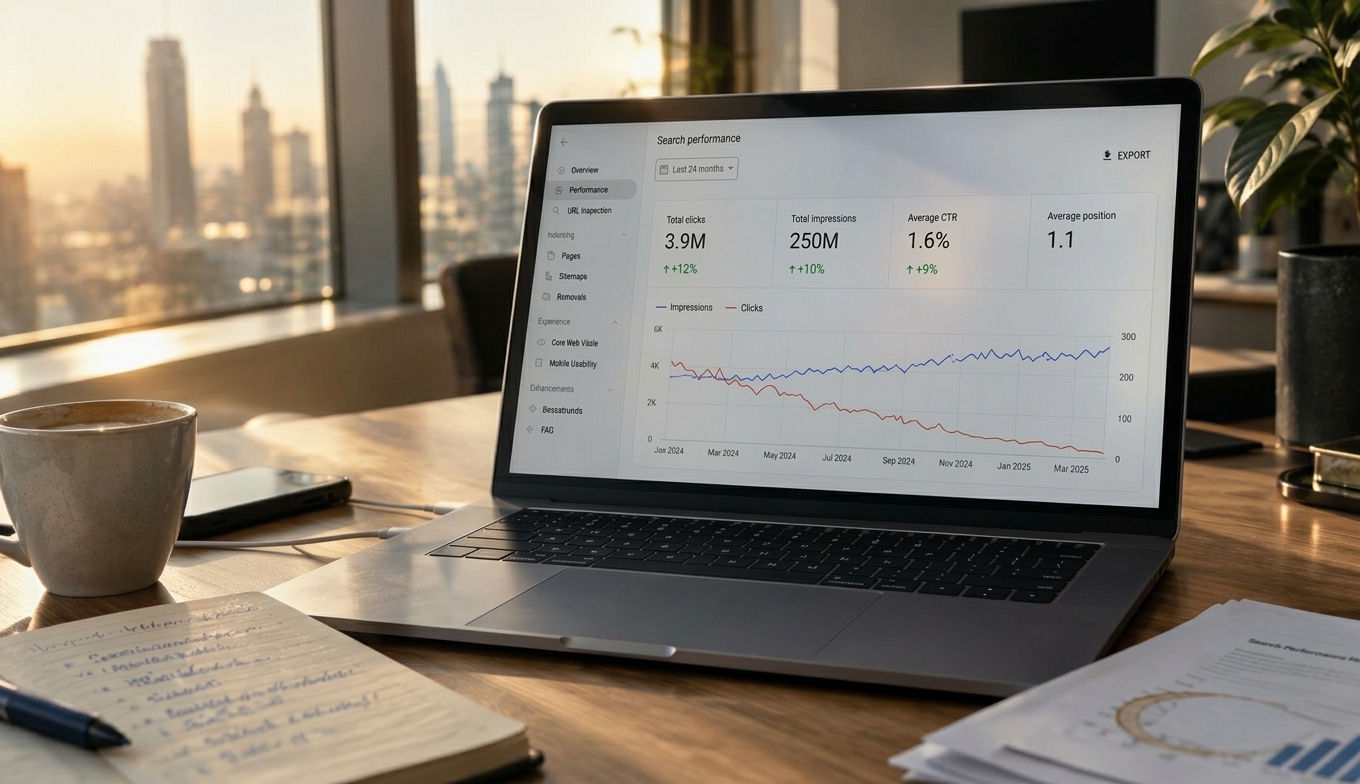
If your organic traffic has dipped while your rankings look fine, this is probably why. Nothing is broken on your side. The page your customers look at has simply changed.
How buyers use ChatGPT and Gemini to shortlist businesses
In an April 2026 survey of 1,009 US consumers, 77.6% said they'd used AI to help with a purchase decision in the previous six months. Product research was the most common reason. Among those shoppers, 77.56% used ChatGPT and 58.21% used Gemini. (Search Engine Land)
Picture how that actually plays out. It's late, someone is on their phone, and instead of typing "real estate agency Dubai" they ask a full question:
"Which agencies in Dubai Marina are good with off-plan resales?" "Which skincare brands deliver to Riyadh in under three days?" "Who can rebuild a B2B website in Tunis properly?"
The AI answers with three or four names and a reason for each. That's the shortlist. It's made before anyone opens your website.
I'll be honest about one thing: most of this data is American. I haven't seen a GCC or North African study at this scale, and I'm not going to invent one. But the tools are the same ones, and so is the logic they use to pick names. If your buyers carry a smartphone, they carry an answer engine.
Why AI search skips good businesses
Classic SEO was built for a list of ten links. The buyer did the choosing.
AI search doesn't give a list. It writes one answer and names a few businesses inside it.
Being on page one and being in the answer are now two different things.
Here is what is actually happening. AI models don't reward the best business. They reward the most legible one. They build answers from sources they can read, check and quote with confidence.
So think about what most growth-stage websites look like from a machine's point of view. A homepage tagline instead of a plain sentence about what the company does. Service pages that could belong to anyone. No structured data. Very few mentions anywhere else on the web.
That business isn't skipped because it's bad. It's skipped because it's unreadable.
We've written before about the digital infrastructure gap: a 9/10 business marketed like a 3/10 company. On Google, that gap cost you clicks to sharper-looking competitors. In AI search, it can cost you the shortlist entirely.
Why AI search visibility is a revenue problem, not a traffic problem
The easy reading is "we're losing traffic." The more expensive reading is what happens to the decisions you can't see.
The visitors who still click are further along. Studies disagree on how much better AI-referred visitors convert, and ecommerce looks like the exception for now. But for services and B2B, I haven't found a credible study showing them converting worse. The AI has already done the comparing for them. (AirOps, Alian Software)
The real decision happens off your dashboard. A buyer who hears a competitor's name in ChatGPT shows up weeks later as "direct" traffic or a branded search. Your reports credit the wrong channel, and next quarter's budget follows it.
Being named lifts your paid ads too. Seer Interactive's 2026 data shows brands cited inside AI Overviews earned a 15.74% paid click-through rate on the same searches, compared with 11.19% when they weren't cited. (TechWyse)
So being in the answer isn't a vanity metric. It sits upstream of almost every number you already report on.
How to get your business recommended by AI: a 5-part GEO checklist
Generative engine optimization (GEO) sounds technical. Most of it is just making your business easy to understand. None of it is a hack. It's infrastructure, and like all infrastructure, it compounds.
1. Say clearly who you are
Put one plain paragraph on every key page: what you do, who it's for, and where you work. AI quotes clear sentences. It can't quote a slogan.
2. Add structured data
Organization, Service, FAQ and Article schema tell machines what your pages mean, not just what they say.
3. Answer the questions buyers actually ask
"How long does an ecommerce site rebuild take?" will get you cited. "Welcome to our world of digital excellence" won't.
4. Earn proof on sites you don't own
Directories, press, reviews, partner pages. AI trusts what others say about you more than what you say about yourself.
5. Let the AI crawlers in
Check your robots.txt isn't blocking GPTBot, ClaudeBot, PerplexityBot or Google-Extended. A surprising number of sites block them without anyone deciding to.
The 10-minute test
Write down the five questions your best client asked before they hired you. Ask them in ChatGPT, Gemini and Perplexity. Note whose names come back.
That list is your real competition now. It may not be the list you thought.
Is SEO dead? No, it's the foundation
The lazy conclusion is that search doesn't matter anymore. The data says otherwise. Branded searches, local searches and high-intent buying searches are still far less affected by zero-click behaviour than general information searches. (TechWyse, on SparkToro's data)
What changed is the finish line.
Clear pages, structured data and real authority are exactly what AI reads. The businesses that built that foundation are being found twice, in the rankings and in the answer. The ones that only bought campaigns are being found in neither.
So the question isn't really whether you rank anymore.
It's this: the last time a potential client asked an AI who to trust in your market, whose name came back?
“Samar Romdhani is Co-Founder of Solando Digital, a performance branding agency working with growth-stage businesses across the GCC, North Africa and West Africa. Before Solando, she founded Styx Agency and served as Digital Marketing Lead for Cookie Labs in Abidjan, leading execution across its client portfolio, including African Digital Week and UNETEL.
FAQ
AI search visibility is how often a business is named or cited when buyers ask tools like ChatGPT, Gemini, Perplexity or Google’s AI Overviews a question about its market. It measures presence inside the answer, not position on a results page.
Generative engine optimization is the work of making a business easy for AI models to understand, trust and cite. It combines clear entity statements, structured data, answer-shaped content, independent mentions and open crawler access.
Yes. Branded, local and high-intent transactional searches remain far less affected by zero-click behaviour, and the same foundations that support rankings are what AI engines read. SEO is now the foundation of AI visibility, not a separate channel.
Ask ChatGPT, Gemini and Perplexity the five questions your best clients asked before hiring you, and record which businesses are named. Repeat monthly to track movement.
Yes. Buyers in the region use the same AI tools, and AI engines apply the same logic when choosing which businesses to name, regardless of market.
Make your business easy to understand and verify. State plainly what you do, for whom and where; add structured data; publish pages that answer buyers’ real questions; earn mentions on independent sites; and make sure your robots.txt allows AI crawlers such as GPTBot.